
The Succession Plan That Only Lives in Your Head
New survey data confirms something I see in almost every service business I evaluate. Owners believe they have handled succession long before they actually have.
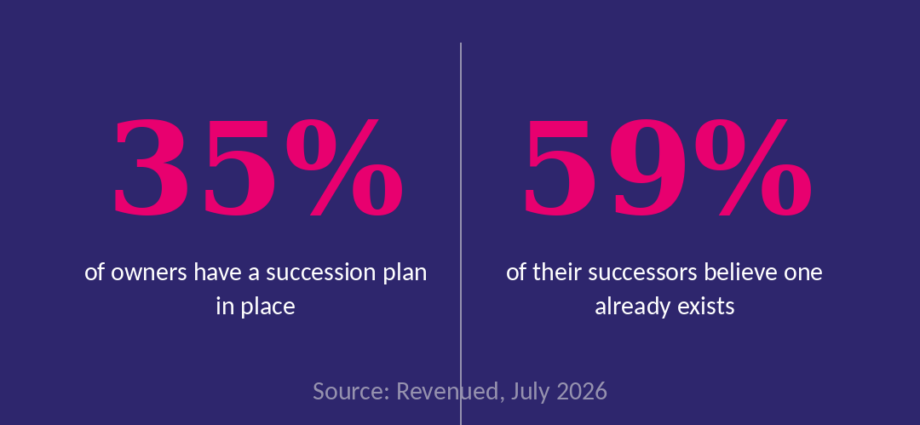
Fintech company Revenued published research this month comparing small business owners to the people who expect to take over their business one day, whether that is an adult child, a business partner, or a longtime employee. The findings show a 24-point gap between what owners believe about their own readiness and what their successors assume is already true.
Just 35% of surveyed small business owners said they have any succession plan in place. At the same time, 59% of their potential successors believe a plan already exists. Someone in that relationship is going to be surprised, and it is usually the person who has not put anything in writing.
The plan and the systems are the same project
Succession planning and operational systems get treated as two separate projects. They are one project with two names.
The systems that let an owner work less and profit more are the same systems a buyer or successor inherits. In many service businesses, the successor is purchasing those systems, not the name on the door or the client list. If the systems that run daily operations live in the owner’s head, in scattered notes, or in habits nobody else has been trained on, there is nothing to hand over. There is a business that runs only as long as the owner keeps showing up.
A written succession plan without systems documentation is a signature waiting for a lawyer. A set of documented procedures without a succession plan is a manual nobody has been told they will need.
Where the gap comes from
Revenued’s data found that owners in business more than 10 years were the least likely to have identified a successor, at just 29%. Owners in their 6th through 10th year were the most likely, at 39%.
That pattern tracks with what I see in practice. The longer an owner runs daily operations personally, the more of the business exists only as instinct, and instinct is hard to hand off. It rarely survives a single conversation at a holiday dinner table.
What this means depending on which side of the desk you sit on
If you are the owner, start with documentation, not the attorney’s office. Write down the decisions you make by feel, the vendor relationships only you manage, and the client judgment calls nobody else has been trained to make. The legal paperwork moves fast once that exists.
If you are the successor, ask to see what is actually written down before assuming it exists. A verbal agreement is a different thing entirely from a documented system.
The consequence
About 65% of small business owners have no documented succession plan. Most are still confident their business would keep running fine without them in the room. That confidence has rarely been tested against anything harder than a long weekend away.
A written succession plan is proof that a business runs on structure instead of memory. When that proof is missing, the gap surfaces at the worst possible moment, and it is the successor who inherits the surprise.
Read the article here.
If you want a clear picture of where your business still depends on you personally, the Independence Snapshot takes 8 questions and shows you the fastest fix first.
Originally published on DailyPrincipal.com by Lindsey Korell, CEO & Operation Strategist, The Succession Plan that Only Lives in your head